Welcome to SETEK Technology
Containerized Data Centers — From Design to Operation
SETEK brings together project engineering, manufacturing coordination and system integration to develop containerized data center infrastructure tailored to customer requirements.
Starting with the intended workload, IT capacity and installation conditions, we define the equipment configuration and translate it into practical design and manufacturing specifications. Power, cooling, racks, monitoring and maintenance access are considered together to create an integrated infrastructure platform.
From individual edge deployments to high-density AI installations and multi-container facilities, our approach connects project requirements with production, site installation and commissioning.
What Is a Containerized Data Center?
The infrastructure needed to operate servers, organized within a container.
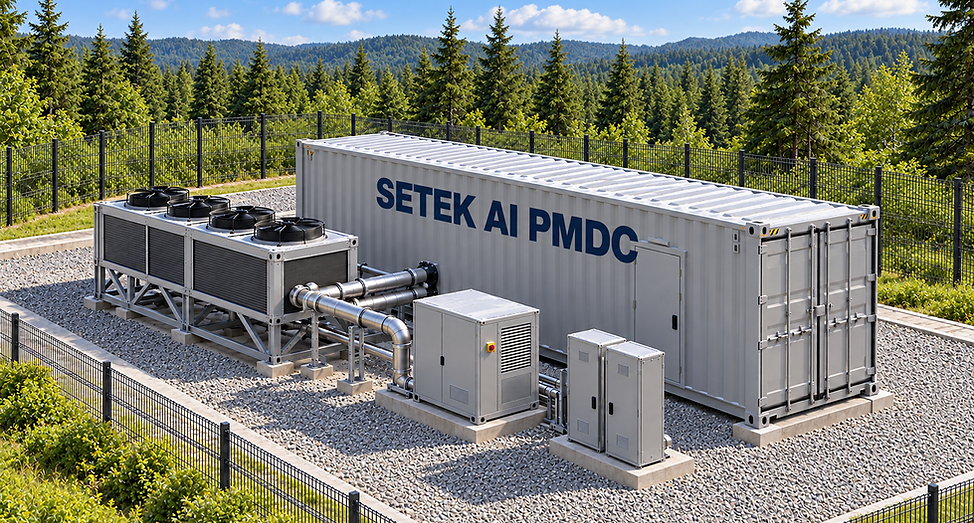
A containerized data center brings together server racks, electrical distribution, cooling, monitoring and maintenance space within a transportable enclosure. It allows computing infrastructure to be installed where it is needed, with a configuration adapted to the workload and site conditions.
Rather than relying solely on a server room constructed inside a conventional building, organizations can deploy computing capacity through container-based infrastructure. The enclosure and its internal systems are engineered together, taking account of equipment loads, environmental conditions, service access and connections to external utilities.
A containerized data center is therefore more than an enclosure for IT equipment. It is an integrated infrastructure system designed to support the operation of that equipment.
Integrated Data Center Functions
Racks, power distribution, cooling, cabling, monitoring and maintenance access are planned as a coordinated system. Their interfaces are defined during design to support installation, operation and future servicing.
Start at the Required Scale
The configuration can be developed around the initial workload, GPU deployment, rack density and available power capacity. Additional units can be incorporated as demand grows, provided that the site layout and supporting infrastructure allow for expansion.
Adapt to the Installation Site
Containerized infrastructure can serve existing facilities, industrial sites, research campuses, regional locations, business continuity sites and locations close to suitable power sources. Each deployment is assessed against its environmental, logistical and operational requirements.
Why Containerized Infrastructure for AI?
AI infrastructure is moving toward faster deployment and phased expansion.
High-density GPUs place greater demands on electrical capacity, cooling performance and deployment speed. At the same time, computing requirements can change rapidly as organizations introduce new applications, expand AI services or adopt different server platforms.
Containerized infrastructure provides an approach to deploying the required computing environment at the required location and scale. It supports a project strategy in which infrastructure can be manufactured, integrated and tested before delivery, while site preparation progresses in parallel.
01 — AI Demand Does Not Wait for Buildings to Be Completed
Computing demand can emerge quickly, and the required capacity may change during the development of a project.
A phased approach allows organizations to plan an initial deployment around current needs while preparing for subsequent expansion. Container units can form part of that strategy, with shared power, cooling and network infrastructure sized according to the agreed growth plan.
02 — GPUs Have Changed Power and Cooling Requirements
High-density GPU systems increase power consumption and heat output per rack. Their infrastructure must be designed around the actual server configuration and operating conditions.
Electrical distribution, cooling capacity, redundancy, monitoring and maintenance access need to be considered from the beginning. In liquid-cooled deployments, the interfaces between servers, CDUs, pipework and external heat rejection equipment also require coordinated engineering.
03 — Computing Infrastructure Can Be Deployed Closer to Demand and Power
Deployment locations are becoming more diverse, including edge sites, factories, research facilities, regional hubs and business continuity locations.
Locating computing infrastructure near its users, applications or suitable energy infrastructure can support project objectives. The final location must also provide appropriate connectivity, site access, utility connections and operating support.
SETEK Engineering & Integration
Turning project requirements into a coordinated infrastructure design.
SETEK evaluates the workload, equipment configuration and site conditions to establish a practical engineering basis for each project. The objective is to define how the container, its internal systems and the external infrastructure will function together.
Requirements and Capacity Planning
We assess IT load, rack count, rack power density, server configuration, ambient conditions and future expansion requirements. These inputs guide the selection of the enclosure, electrical architecture, cooling concept and equipment layout.
Power Infrastructure
The electrical scope can include incoming supply interfaces, distribution panels, UPS systems, PDUs, grounding and power monitoring. Capacity and redundancy are defined according to the project’s operational requirements.
Cooling and Thermal Integration
Cooling is selected according to the IT equipment, heat load, ambient conditions and available utilities.
Depending on the project, the configuration may incorporate air cooling, direct-to-chip liquid cooling, rear-door heat exchangers or other validated cooling technologies. For liquid-cooled systems, engineering includes CDU integration, supply and return pipework, flow and pressure requirements, leak detection and external heat rejection.
Server-side and facility-side requirements are coordinated to establish a compatible thermal system.
Layout, Monitoring and Maintenance
Rack positioning, cable routes, pipework and service clearances are developed together. Monitoring can include temperature, power consumption, cooling-system conditions, liquid leakage and equipment alarms.
The design also considers access for inspection, component replacement and routine maintenance.
From Requirements to Commissioning
A coordinated process from the initial brief to operational handover.
01 — Requirements Definition
Establish the workload, capacity, rack density, cooling requirements, redundancy objectives and installation conditions.
02 — Engineering Design
Develop the enclosure layout and define electrical, cooling, piping, cabling, monitoring and site interfaces.
03 — Manufacturing and Integration
Coordinate enclosure production and equipment integration against the agreed specifications. Factory acceptance testing is planned around the project scope and available test conditions.
04 — Site Installation
Coordinate delivery, positioning and connections to the site’s electrical, cooling, network and other supporting infrastructure.
05 — Commissioning and Handover
Complete the agreed site acceptance checks, functional testing, monitoring configuration and handover documentation to support operation.
Explore Our Container Data Center Solutions
Discover SETEK’s container data center configurations and discuss the engineering requirements of your project.
The appropriate solution starts with your workload, deployment location and operating objectives.